
Why Surge Built on Taproot
Most of Bitcoin remembers Taproot as a privacy and fee upgrade. That's the smallest version of the story - and the whole Surge credit architecture depends on the larger one.
 Yash Belavadi4 min read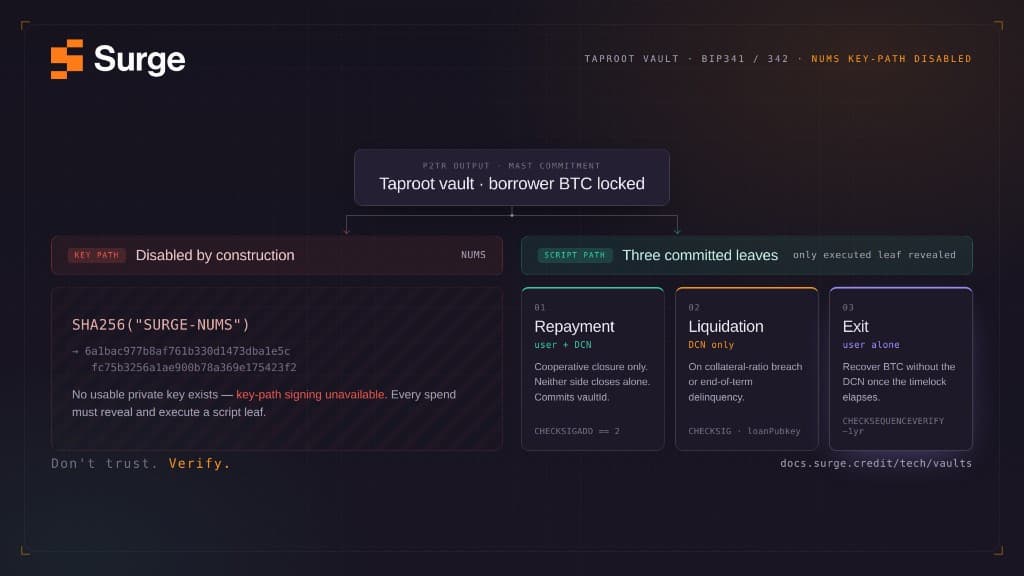
Most of Bitcoin remembers Taproot as a privacy and fee upgrade. That framing isn't wrong, but it's the smallest version of the story.
What Taproot actually shipped was the most expressive programmable upgrade Bitcoin has ever had - and almost nobody is building on what it really unlocked. Our entire credit architecture depends on it, so here's the reasoning.
What Taproot actually gave us
A Taproot output commits to two things at once: a key path, and a tree of spending scripts written in Tapscript (a MAST tree).
The clever part is that the tree lives off-chain and never touches the blockchain unless someone actually uses a branch - and even then, only the branch used is revealed while the rest stay hidden. You commit to many conditions up front, prove exactly one when the time comes, and leak nothing else.
That's not a fee optimization. That's programmable money with privacy built into its structure, and it took zero changes to Bitcoin's consensus rules.
The few teams genuinely pushing this prove how deep it goes. Ark pools many users into a single Taproot output, where each leaf is a virtual UTXO and every user keeps the right to exit unilaterally. BitVM goes further still, committing an entire computation to a Taptree - one leaf per logic gate - and only touching the chain in the event of a dispute.
Radically different projects, same underlying insight: the script tree is a real substrate for programmable contracts, and the surface has barely been scratched.
The Surge Vault
We're building the largest non-custodial, Bitcoin-native credit book ever. A Surge Vault is a Pay-to-Taproot output (BIP341) that holds your BTC and can only move when one of three pre-committed spend paths is satisfied.
And the whole design starts with the internal key - specifically, with making it impossible to use.
A live key path would be a backdoor: a way collateral could move without satisfying the contract. So Surge sets the Taproot internal key to a NUMS point ("Nothing Up My Sleeve"), derived deterministically from SHA256("SURGE-NUMS"), producing an x-only key (6a1bac…175423f2) with no corresponding private key in existence.
Because the internal key is NUMS, key-path signing is simply unavailable. Every spend must reveal and execute a script leaf.
🚨 There's no hidden backdoor you have to trust we won't use. There's a hash you can recompute yourself and confirm. Don't trust that we won't move your coins. Verify that we can't. 🚨
The three leaves
With the key path dead, all three legitimate ways the collateral can move live in the Tapscript tree, in the open.
Repayment. The user and the DCN co-sign - an OP_CHECKSIGADD threshold of two - so it's cooperative closure only, and neither side can close the vault alone. The leaf commits a vaultId that binds the UTXO to your on-chain position, so a valid witness can't be replayed against a different vault.
Liquidation. Spendable with the DCN's signature, but authorized only on a collateral-ratio breach or unpaid end-of-term delinquency. It's the same script with a defined trigger, not a discretionary lever anyone pulls.
Exit. The path that matters most. The leaf enforces OP_CHECKSEQUENCEVERIFY, a relative timelock of roughly one year, after which it requires only your signature. If the DCN and the entire coordination layer disappear, you wait out the timelock and recover your Bitcoin alone - no permission, no counterparty.
This isn't a clause in a terms-of-service document that assumes the company still exists to honor it. It's a recovery guaranteed by Bitcoin script itself. The whole point of non-custodial is that your control survives the failure of every other party, and the Exit leaf is where that survives or dies.
The inversion the market skipped
Custodial lending asks you to trust your coins are still there, still yours, still un-rehypothecated. Surge replaces that trust with verification: a NUMS key you can recompute, three leaves you can read, an exit enforced by a timelock.
Bitcoin script is the final authority. Off-chain services can request actions, but BTC only moves when a committed leaf is satisfied on-chain.
Taproot wasn't the convenient choice. Convenient would have been holding the coins ourselves. It was the only choice consistent with building credit a Bitcoin holder can actually verify - and actually walk away from.
Full vault spec: docs.surge.credit/tech/vaults
Don't trust. Verify. 🟧